
Jesmond Park Academy

Performance Arts
We believe the Performing Arts are not just an extra-curricular activity. They are where students from all backgrounds find new ways of expressing themselves and of understanding the world around them. The arts are what distinguish human beings from robots. They are what make us distinctively human.
Performing Arts Department Curriculum Philosophy and Intent Statement
We feel it is important for students to participate in and learn about the Performing Arts because they are a positive force in society: students who participate feel more confident in their ability to create, challenge and explore, to be part of society, and to make change happen.
Research shows studying the arts can improve a young person’s cognitive abilities and contribute to raising young people’s attainment in many subjects and from all backgrounds. The arts also creates a culture of citizenship, tolerance and empathy. Children who engage in the arts are more likely to volunteer and to vote.
Creativity is a disciplined process that requires skill, knowledge and control. Through our passion and expertise as teachers, we strive to instil a love of the arts. Our subject allows students to develop their oracy and collaboration skills alongside reading and writing.
We endeavour to create an environment that is stimulating, collaborative, enriching, inquiring and creative. A place that opens young people’s minds and allows them to question and explore the world around them.
Music is a universal language that embodies one of the highest forms of creativity.
At Jesmond Park Academy we encourage pupils to develop a love of music and their talent as musicians by performing on instruments, singing, composing and listening to a wide range of music in and outside our timetabled curriculum lessons. We intend to engage and inspire pupils to develop a love of music and their talent as musicians, and so increase their self-confidence, creativity and sense of achievement.
We want all students to develop a critical engagement with music, allowing them to find new ways to express themselves and understand the world around them. Have the confidence to question, create, challenge, explore, be part of society, and to make change happen.
To appreciate the arts through active involvement as creators, performers and critics. As pupils progress, they should develop a critical engagement with music, allowing them to compose, and to listen with discrimination to the best in the musical canon.
Why do we study Music?
Music Education enhances learning and communication skills, creativity, teamwork, discipline, cultural awareness, respect for others, and self-esteem through personal accomplishment.
MUSIC is accessible to everyone and all levels of ability and has a significant number of amazing benefits to offer. Studies have shown that those who study music perform better in a variety of academic subjects, including math, science, reading, and language. It develops social skills, which promotes positive emotional wellbeing through use and development of imagination, creativity, empathy, collaboration. When we play music, all areas of the brain are activated.
When studying Music, your brain needs to simultaneously process different pieces of information at quick speeds. When playing music, you are strengthening the bridge between your logical left hemisphere and your creative right hemisphere. So, the more you practice, the more this bridge is developed. This means that musicians are more likely to create, store, categorise, retrieve and process information quicker and craft creative solutions, ideal for both academic and social situations.
Although we appreciate when you learn music in school, not all will become professional musicians however studying music develops transferable life skills such as…
- Personal organisation, self-discipline, time management and dedication to succeed in a competitive field
- Event management and teamwork skills will show employers you can come up with creative solutions and work with others effectively
- Communication skills will be enriched each time you research, analyse and interpret complex information to form concise, compelling and coherent arguments
- Maintaining good physical and mental health and overall well-being through musical involvement (whether it be in groups, creating or performing).
The creative industries now contribute over £84.1 billion a year to the UK economy. Music graduates are highly employable across a very wide range of specialisms and professions.
At Jesmond Park Academy, we want students to be involved and enjoy Music both inside and outside of the classroom. To develop independence, teamwork, adaptability, creativity as well as being innovative thinkers with a healthy wellbeing…ready for the future.
Performing Arts Curriculum Content Statement
Drama
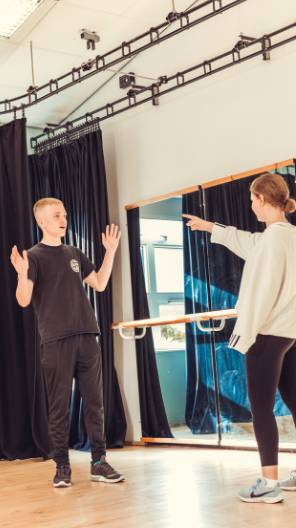
The content of the Drama curriculum explores the cultural and historical context in which Drama originates and is performed. Students will develop knowledge and understanding of: the characteristics of key performance texts and dramatic works, how meaning is interpreted and communicated, the roles and responsibilities of theatre makers and subject specific terminology and how to use it appropriately. Through the areas of creating, performing and evaluating students will revisit knowledge, skills and terminology every year and apply them to new and more demanding contexts.
Music
We aim to create music students who can:
- Perform with musicality showing technique, expression and interpretation as well as accuracy and fluency. This includes singing alongside instrumental.
- Compose with their own compositional voice showing they can develop their musical ideas, have strong technical control and coherence.
- Appraise a wide range of music applying a strong understanding of context, stylistic features, structure and musical elements to express and justify opinions and preferences.
Through these three skill sets, the following three pillars of progression will be covered:
- Technical: developing motor skills to develop competence in controlling sound (instrumental, vocal and music technology) and use of a communication system such as staff notation or guitar tab etc.
- Constructive: knowledge of the musical elements/interrelated dimensions of music and knowledge of the components of composition.
- Expressive: extensive listening opportunities to help develop students’ expressive intentions, alongside tasks at a technical level appropriate for students to realise their expressive intentions.
Key Knowledge and understanding (KS3 & KS4)
Three key areas of knowledge & understanding flow through KS3 &4:
- Musical elements
- Musical contexts
- Musical language